


February 12, 2026
February 12, 2026
.avif)
Digital marketing has become a core driver of business growth, shaping how brands attract customers, generate leads, and scale revenue. As marketing demands grow more complex, many businesses face a strategic decision: should marketing be handled by an in-house team or outsourced to a digital marketing service? While both models can deliver results, they differ significantly in cost structure, expertise, flexibility, and long-term impact.
This article offers a clear, practical comparison between in-house marketing and digital marketing services, helping businesses understand the strengths, limitations, and ideal use cases of each approach. By the end, you’ll be better equipped to choose a marketing model that supports sustainable growth, not just short-term execution.
In-house marketing refers to a business model where all marketing activities are handled internally by a dedicated team employed directly by the company. Instead of outsourcing strategy or execution to external partners, businesses build their own marketing department to manage planning, implementation, and performance optimization across various channels.
This model is commonly adopted by companies that want greater control over brand messaging, faster internal collaboration, and long-term ownership of marketing knowledge. In-house marketing teams work closely with leadership, sales, and product teams, ensuring that marketing strategies are closely aligned with business objectives.
An in-house marketing team can vary in size depending on the company’s scale and budget. However, most teams typically include several core roles, each responsible for a specific function within the marketing ecosystem:
In smaller organizations, one person may handle multiple roles, while larger companies often build specialized teams for each channel.
In-house marketing teams are responsible for managing both strategic planning and daily execution. Their responsibilities often include:
Because they operate within the organization, in-house teams often have deep insights into products, customers, and internal processes, an advantage that can improve messaging accuracy and brand consistency.
In-house marketing is often a strong choice for businesses with stable budgets, clear long-term growth plans, and a need for constant brand management. Companies in regulated industries, large enterprises, or organizations with complex products may prefer this model to maintain tighter control over communication and data.
However, building and maintaining an in-house team also requires significant investment in salaries, training, tools, and ongoing skill development, factors that businesses must carefully evaluate before committing to this approach.
A digital marketing service refers to the outsourcing of marketing strategy, execution, or both to an external agency or service provider that specializes in digital channels. Instead of building and managing an internal marketing team, businesses partner with professionals who deliver targeted marketing solutions designed to achieve specific goals such as brand awareness, lead generation, or revenue growth.
.avif)
Digital marketing services are widely used by startups, small and medium-sized enterprises, and even large organizations that require advanced expertise, scalability, or faster execution without the long-term commitment of hiring full-time staff. These services allow businesses to tap into a broad range of skills and technologies while maintaining flexibility in budget and scope.
Digital marketing services can be structured in different ways depending on business needs. Common models include:
This variety allows businesses to choose a service model that aligns closely with their marketing priorities and growth stage.
Most digital marketing services cover a wide range of disciplines, enabling businesses to access multi-channel expertise without building separate internal teams. These services often include:
By working with a digital marketing service, businesses gain access to experienced specialists who stay up to date with platform changes, algorithms, and industry best practices.
Unlike in-house teams, digital marketing services operate as external partners. They typically begin with a discovery phase to understand business goals, target audiences, and competitive landscapes. From there, strategies are developed, executed, and continuously optimized based on performance data.
Regular communication, reporting, and clearly defined KPIs are essential to ensure alignment between the business and the service provider. When managed effectively, this partnership can deliver measurable results while allowing internal teams to focus on core business operations.
Digital marketing services are particularly suitable for businesses that need quick access to expertise, advanced tools, or scalable marketing execution. Companies facing rapid growth, limited internal resources, or highly competitive markets often benefit from outsourcing to experienced providers.
While this model offers flexibility and efficiency, success depends heavily on choosing the right partner and maintaining clear communication, expectations, and performance benchmarks.
Choosing between an in-house marketing team and a digital marketing service is not just an operational decision, it’s a strategic one. The two models differ significantly in how they impact cost efficiency, performance, scalability, and long-term growth. Below are the key factors businesses should consider when comparing these approaches.
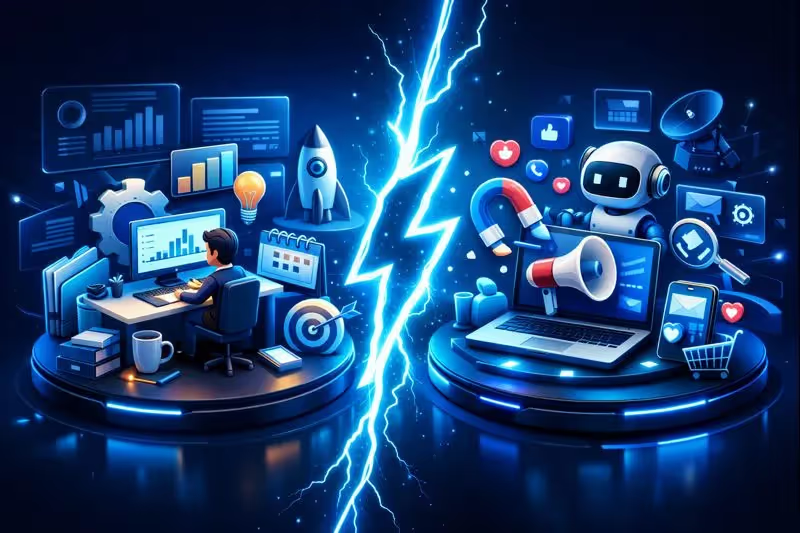
In-house marketing involves fixed, ongoing costs. Businesses must account for salaries, benefits, training, software subscriptions, and recruitment expenses. Even a small in-house team can represent a substantial long-term investment, regardless of short-term performance or campaign demand.
Digital marketing services, on the other hand, typically operate on flexible pricing models such as monthly retainers, project-based fees, or performance-based contracts. This allows businesses to control costs more effectively, scale spending up or down, and avoid long-term financial commitments, making outsourcing particularly attractive for growing companies or those with limited budgets.
An in-house team often consists of a limited number of specialists, which can restrict expertise across all digital channels. Keeping internal staff up to date with rapidly evolving platforms, algorithms, and best practices also requires continuous training and investment.
Digital marketing services provide immediate access to a broad range of specialists, including SEO experts, paid advertising managers, content strategists, and data analysts. Agencies work across multiple industries and campaigns, allowing them to apply proven strategies and insights that may not be available within a single organization.
Scaling an in-house marketing team takes time. Hiring new talent, onboarding, and aligning processes can slow down execution, especially during periods of rapid growth or seasonal demand.
Digital marketing services offer greater agility. Campaigns can be launched quickly, adjusted in real time, and scaled efficiently without internal hiring delays. This flexibility allows businesses to respond faster to market changes, competitive pressure, or new opportunities.
In-house teams must invest individually in marketing tools, analytics platforms, and automation software, often at a high cost. Managing and integrating these tools also requires technical expertise.
Digital marketing services typically leverage advanced, enterprise-level tools as part of their offering. With access to sophisticated analytics, AI-driven optimization, and cross-campaign data, agencies can deliver deeper insights and more precise performance improvements without additional tool costs for the business.
In-house marketing teams offer greater direct control and closer alignment with internal stakeholders. Communication is often faster, and brand understanding tends to be deeper due to daily immersion in the business.
Digital marketing services operate externally, which can introduce communication gaps if expectations and processes are not clearly defined. However, experienced agencies mitigate this through structured reporting, regular strategy reviews, and clear performance metrics, ensuring brand consistency while maintaining execution efficiency.
There is no universal answer to whether in-house marketing or digital marketing services are better for a business. The right choice depends largely on your company’s size, growth stage, internal capabilities, and long-term objectives.
For startups and small businesses, digital marketing services are often the more practical option. Limited budgets, lean teams, and the need for rapid execution make outsourcing an efficient way to access professional expertise without the overhead of full-time hires. Digital marketing services allow smaller companies to test channels, validate strategies, and scale results quickly while maintaining financial flexibility.
Mid-sized businesses typically face a more complex decision. At this stage, companies may have internal resources but still lack specialized expertise across all digital channels. Many find that relying solely on an in-house team can slow innovation or stretch capabilities too thin. In these cases, digital marketing services like Markdao can complement internal efforts by providing strategic direction, advanced execution, or campaign-based support where expertise is missing.
Larger organizations and enterprises often benefit from in-house marketing teams due to the need for tighter brand control, cross-department collaboration, and long-term knowledge retention. However, even at this level, external digital marketing services remain valuable for specialized projects, performance optimization, or entering new markets where speed and expertise are critical.
Ultimately, the best option is the one that aligns marketing execution with business goals while maximizing efficiency and return on investment. Businesses that clearly assess their resources, expectations, and growth priorities are far more likely to choose a marketing model that supports sustainable success rather than short-term output.
Many businesses are discovering that the most effective approach is not choosing between in-house marketing and digital marketing services, but combining both into a hybrid model. This approach leverages the strengths of internal teams while supplementing them with external expertise, creating a more balanced and scalable marketing operation.
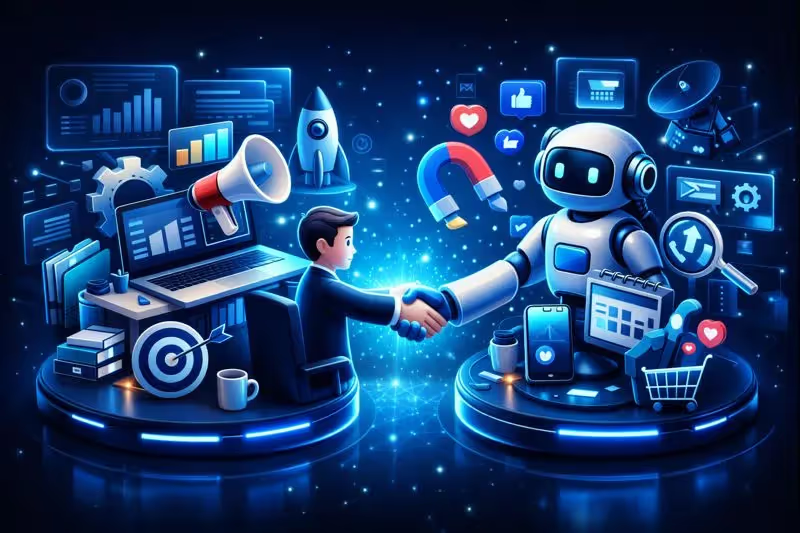
In a hybrid model, the in-house team typically focuses on brand strategy, messaging, internal coordination, and long-term planning. Because they work closely with leadership, sales, and product teams, internal marketers are well positioned to maintain brand consistency and ensure marketing efforts align with business priorities. Meanwhile, digital marketing services are brought in to handle specialized execution, advanced optimization, or high-impact campaigns that require deep technical expertise or rapid scalability.
This combination allows businesses to remain agile without overextending internal resources. Instead of hiring multiple specialists for every channel, companies can rely on digital marketing services for areas such as SEO, paid advertising, analytics, or conversion optimization, while keeping strategic control in-house. The result is often faster execution, improved performance, and better use of marketing budgets.
The hybrid model is particularly effective for growing companies that need both structure and flexibility. It enables businesses to scale marketing efforts during peak periods, enter new markets with confidence, and adopt new technologies without long onboarding cycles or long-term hiring commitments. When managed with clear roles, communication processes, and performance metrics, this approach delivers the best of both worlds: strategic alignment from within and execution excellence from experienced external partners.
Conclusion
Choosing between in-house marketing and digital marketing services is less about finding a “better” option and more about finding the right fit for your business. Each model offers distinct advantages, and the real value lies in how well it supports your goals, resources, and growth ambitions. What matters most is not where marketing is executed, but how effectively it drives measurable results.
As markets evolve and digital channels become more complex, businesses that remain flexible gain a clear competitive advantage. Whether you rely on an internal team, partner with a digital marketing service, or adopt a hybrid approach, success comes from strategic clarity, consistent execution, and data-driven decision-making. Companies that invest in the right structure, and the right expertise, are far better positioned to grow sustainably in a rapidly changing digital landscape.