


December 15, 2025
December 15, 2025
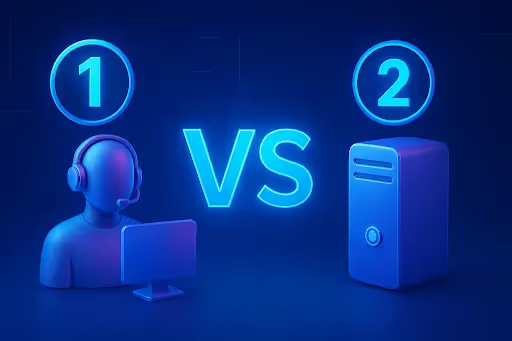
As businesses grow more dependent on technology, the demand for fast, reliable, and well-structured IT support becomes indispensable. Yet one common challenge remains: many organizations are unsure how Level 1 Support truly differs from Level 2 Support, and why that distinction matters. Understanding the roles, skill sets, and workflows of each level can help you streamline operations, reduce downtime, and deliver a smoother user experience. This article breaks down L1 vs L2 Support in a clear and practical way, giving you the insights you need to build an efficient, cost-effective support model.
Level 1 Support (L1 Support) is the first line of assistance in an organization’s IT support structure. It serves as the user’s primary point of contact, handling initial inquiries, troubleshooting basic issues, and ensuring every request is properly logged and categorized. L1 teams are designed to resolve high-volume, low-complexity problems quickly, keeping the support process efficient and preventing unnecessary escalations.
Level 1 Support focuses on frontline problem-solving. These agents address common issues such as login failures, software navigation questions, or basic configuration errors by following standardized procedures or knowledge base articles. Their goal is to deliver fast solutions and maintain user satisfaction while filtering and organizing tickets for higher-level teams.
.avif)
Main Responsibilities
L1 Support plays a crucial operational role by managing a broad range of user-facing issues, including:
Skills Required
Because L1 agents interact directly with end users, they must combine foundational technical knowledge with strong communication abilities:
Typical Tools Used
To manage high-volume inquiries efficiently, L1 teams rely on:
Level 2 Support (L2 Support) is the second line of technical expertise within an organization’s IT support structure. This team handles issues that Level 1 cannot resolve, typically those requiring deeper technical knowledge, advanced diagnostic skills, and a strong understanding of system architecture. L2 Support plays a critical role in minimizing downtime, maintaining system stability, and ensuring complex incidents are addressed thoroughly rather than merely patched.
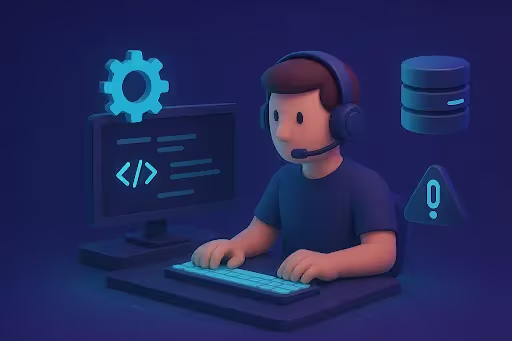
Level 2 Support focuses on advanced troubleshooting and root-cause investigation. Unlike L1, which follows predefined scripts or knowledge base articles, L2 engineers apply in-depth analysis to problems involving system configurations, network performance, operating systems, databases, integrations, and application-level errors. Their primary goal is to provide durable solutions, not just temporary fixes and ensure the issue does not recur.
Main Responsibilities
L2 Support manages higher-complexity technical issues that require specialized skills, including:
Skills Required
Because L2 engineers work on complex technical problems, they require a significantly more advanced skillset:
Typical Tools Used
To handle advanced support tasks, L2 teams rely on specialized tools such as:
While Level 1 and Level 2 Support work together within the same support ecosystem, the gap in their responsibilities, skillsets, and impact on business operations is substantial. Understanding their differences helps organizations build a more efficient escalation workflow and allocate resources wisely.
.avif)
The most fundamental difference lies in the scope of issues each level handles.
Level 1 Support deals with high-volume, low-complexity cases: basic troubleshooting, user guidance, password resets, and common software or connectivity problems. Their focus is speed and efficiency, resolving as many frontline issues as possible without escalation.
Meanwhile, Level 2 Support is responsible for deeper, more technical problems that require specialized investigation. These may involve system misconfigurations, network inconsistencies, application errors, or complex bugs that L1 cannot diagnose. L2 engineers perform detailed analysis and aim for permanent fixes rather than quick patches.
Another major difference is the level of technical expertise required.
L1 agents typically possess foundational IT knowledge and rely on predefined scripts, standard operating procedures (SOPs), or knowledge base articles to resolve common incidents. Their strength lies in communication, user handling, and consistent execution.
L2 specialists, on the other hand, must demonstrate advanced technical understanding across operating systems, databases, networks, cloud services, and system architecture. They are expected to interpret logs, run diagnostics, trace root causes, and collaborate on system-level solutions. Their expertise enables them to solve the problems that frontline teams cannot.
Because L1 handles simple requests, their resolution time is typically short. Many issues can be resolved within minutes, leading to faster ticket turnover and improved user experience.
For L2, resolution time varies significantly depending on the problem’s complexity. Some cases require hours or days of investigation, testing, and cross-team coordination. Their work is not just about restoring functionality but ensuring the underlying issue does not happen again. Consequently, L2 resolutions are deeper, more technical, and more strategic.
Level 1 and Level 2 Support differ not only in what they solve but also in how they interact within the support pipeline.
L1 teams are the initial gatekeepers. They collect detailed information, classify the severity, attempt basic fixes, and escalate cases that fall outside their expertise. Their accuracy in documentation directly affects the speed and success of L2 investigation.
L2 teams receive escalated tickets, validate the information, perform root-cause analysis, and craft long-term solutions. They also update the knowledge base so L1 agents can resolve similar future cases independently. This feedback loop strengthens the entire support ecosystem.
From a business perspective, the cost difference is also critical.
Smart organizations balance both levels strategically: L1 handles volume, L2 handles complexity. This alignment ensures cost-efficiency without compromising on technical depth.
Although Level 1 and Level 2 Support operate at different levels of expertise, their collaboration is what ultimately drives a seamless support experience. By understanding the distinctions between them, businesses can design smarter workflows, reduce downtime, and deliver faster, more accurate resolutions to users.
Choosing between Level 1 and Level 2 Support depends on your business’s size, technical complexity, and operational priorities. When your team handles a high volume of repetitive, user-facing issues, Level 1 Support is the most efficient choice. Tasks like password resets, basic troubleshooting, and software navigation questions can be resolved quickly at this level, ensuring fast response times without overloading more specialized engineers.
Understanding when to rely on Level 1 versus Level 2 Support helps your business allocate resources strategically, optimize support performance, and maintain a stable, reliable IT environment. When these two levels are used in harmony, they create a seamless, cost-effective support structure that grows with your business.
Selecting the right support partner is more than a technical decision; it directly influences your business’s productivity, customer satisfaction, and long-term stability.
Choosing the right support partner is ultimately an investment in your organization’s performance and long-term success. With the right team behind you, every issue is handled with precision, every escalation is efficient, and your entire support ecosystem becomes stronger, smarter, and more scalable.
Conclusion
Understanding the difference between Level 1 and Level 2 Support is more than just knowing technical definitions, it’s about building an efficient, scalable, and cost-effective support system. Level 1 excels at handling high-volume, simple issues quickly, keeping users satisfied and freeing up resources. Level 2 tackles complex, technical challenges, performing in-depth analysis and delivering long-term solutions that strengthen your IT infrastructure.
By strategically combining L1 and L2 support and partnering with the right support provider, businesses can reduce downtime, optimize resource allocation, and enhance overall user experience. Investing in a well-structured support ecosystem isn’t just a reactive measure, it’s a proactive strategy that empowers your organization to grow, adapt, and thrive in an increasingly digital world.