


July 29, 2026
July 29, 2026

Building business software has never been easier, or more complicated. On one hand, low-code platforms enable companies to launch applications in weeks with minimal coding. On the other, custom software development empowers businesses to create tailored solutions that deliver lasting competitive advantages.
While both approaches can accelerate innovation, choosing the wrong one may lead to unnecessary costs, limited scalability, or technology constraints down the road. This guide explores the key differences between low-code and custom software development, so you can confidently select the approach that best supports your business today and as it grows in the future.
Low-code development is a software development approach that enables businesses to build applications using visual interfaces, drag-and-drop components, and pre-built modules instead of writing large amounts of code from scratch. By simplifying the development process, low-code platforms allow both professional developers and technically skilled business users to create functional applications in a fraction of the time required for traditional development.
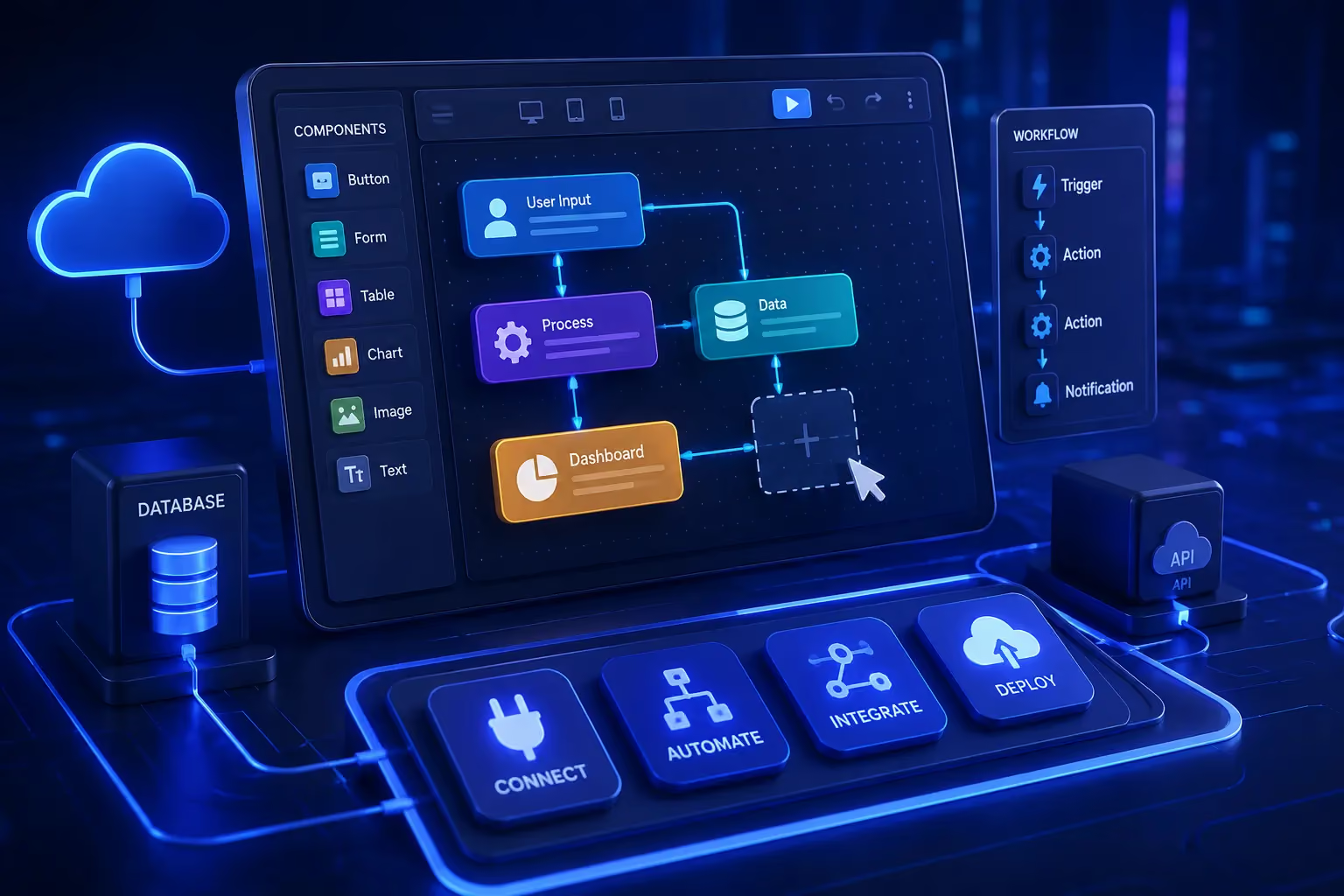
The primary goal of low-code development is to accelerate application delivery while reducing the complexity of coding. Rather than focusing on every technical detail, developers can assemble reusable components, configure workflows, and integrate existing services through intuitive visual tools. This makes it an attractive option for organizations that need to launch applications quickly or automate internal business processes with limited development resources.
Many businesses use low-code platforms to create internal dashboards, workflow automation tools, customer relationship management (CRM) systems, approval processes, employee portals, and minimum viable products (MVPs). These applications can often be developed and deployed within weeks, making low-code an effective solution for projects where speed is a top priority.
Several leading platforms have helped popularize low-code development across industries. Solutions such as Microsoft Power Apps, OutSystems, Mendix, and Zoho Creator provide extensive libraries of templates, connectors, and automation features that enable organizations to rapidly build and deploy business applications with minimal manual coding.
While low-code development offers impressive speed and ease of use, it is not designed for every business scenario. As application requirements become more complex, organizations may encounter limitations in customization, scalability, performance, or integration capabilities. Understanding these strengths and constraints is essential when deciding whether low-code development is the right choice for your business or whether a fully custom software solution would deliver greater long-term value.
Custom software development is the process of designing, building, and maintaining software that is tailored to the unique needs, workflows, and objectives of a specific business. Unlike off-the-shelf software or low-code applications, custom software is developed from the ground up, giving organizations complete control over its functionality, architecture, user experience, and future evolution.

Instead of adapting business processes to fit the limitations of a pre-built platform, custom software is designed to support the way a business actually operates. Every feature, integration, and workflow is carefully planned to address specific operational challenges, improve efficiency, and create a seamless experience for both employees and customers. This flexibility makes custom development particularly valuable for companies with complex requirements or those looking to gain a competitive advantage through technology.
One of the biggest advantages of custom software development is its scalability. As a business grows, its software can evolve alongside it by accommodating higher user volumes, adding new features, integrating with emerging technologies, and supporting changing business models. Organizations also retain full ownership of the source code, eliminating dependency on third-party platforms or licensing restrictions and allowing complete control over future enhancements and maintenance.
Custom software is widely used across industries where performance, security, and flexibility are critical. Businesses often invest in custom solutions to develop enterprise resource planning (ERP) systems, customer portals, financial platforms, healthcare applications, logistics management systems, SaaS products, and AI-powered business solutions. These applications are built to meet industry-specific requirements while ensuring high performance and long-term reliability.
Although custom software development typically requires a larger upfront investment and longer development timeline than low-code platforms, it often delivers greater long-term value. By providing unlimited customization, stronger security, better scalability, and full ownership, custom software enables businesses to build digital solutions that support sustainable growth and adapt to evolving market demands.
Both low-code and custom software development aim to help businesses build digital solutions, but they serve different purposes. Low-code platforms prioritize speed and simplicity, making them ideal for straightforward applications and rapid deployment. In contrast, custom software development focuses on flexibility, scalability, and long-term business value by creating solutions that are fully tailored to an organization's unique requirements.

The right choice depends on several factors, including your budget, project complexity, expected growth, security requirements, and long-term technology strategy. The comparison below highlights the key differences between these two approaches to help you determine which one best aligns with your business objectives.
Ultimately, there is no one-size-fits-all solution. Low-code development is an excellent choice for organizations that need to launch applications quickly, automate routine processes, or validate ideas with minimal investment. Custom software development, on the other hand, is better suited for businesses that require advanced functionality, seamless integrations, stronger security, and the flexibility to scale without being constrained by platform limitations. Evaluating both your immediate priorities and long-term business goals will help you choose the approach that delivers the greatest return on investment.
Cost is often one of the biggest factors when choosing between low-code and custom software development. While low-code platforms generally require a lower upfront investment, it's important to consider the total cost of ownership over the lifetime of the application rather than focusing solely on initial expenses.
Low-code development is typically more affordable at the beginning, with subscription-based pricing and faster development reducing initial costs. However, ongoing licensing fees, user-based pricing, and additional charges for advanced features or integrations can increase expenses as your business grows.
Custom software development usually involves a higher upfront investment because the application is built specifically for your business. However, businesses gain full ownership of the software, avoid recurring platform licensing fees, and have greater flexibility to scale without being tied to a third-party vendor. For organizations with long-term growth plans or complex operational needs, custom software often delivers a stronger return on investment over time.
There is no universally "better" option between low-code and custom software development. The right choice depends on your business objectives, project complexity, available budget, and long-term growth strategy. While low-code can help organizations move quickly with minimal investment, custom software provides the flexibility and scalability needed to support more demanding business requirements. The following scenarios can help you determine which approach best fits your needs.

If your primary goal is to launch an application as quickly as possible, low-code development is often the ideal solution. With visual development tools, reusable components, and built-in integrations, businesses can reduce development time from several months to just a few weeks.
Low-code is particularly well suited for:
For organizations that need to solve immediate operational challenges without extensive technical complexity, low-code offers a fast and cost-effective path to deployment.
As businesses grow, their processes often become too specialized for standard platforms. If your operations require custom workflows, advanced automation, or integrations with multiple business systems, custom software development provides the flexibility that low-code platforms may not be able to deliver.
Custom software is a better choice when you need:
Rather than adapting your business to fit the software, custom development allows the software to be built around your business.
A solution that meets your needs today may not be the best choice in three or five years. While low-code platforms can reduce initial development costs, businesses should also evaluate future expenses, including licensing fees, platform limitations, and potential migration costs.
Custom software typically requires a larger upfront investment but offers greater long-term value through complete ownership, unlimited scalability, and the freedom to evolve as business needs change. For companies planning rapid expansion or digital transformation, investing in a custom solution can reduce future technical constraints and deliver a stronger return on investment.
In many cases, businesses don't have to choose one approach exclusively. A hybrid strategy allows organizations to leverage the strengths of both low-code and custom software development.
For example, a company might use a low-code platform to build internal workflow applications or administrative tools while investing in custom software for customer-facing products, enterprise systems, or mission-critical applications. This approach enables businesses to accelerate development where speed matters most while maintaining the flexibility, security, and scalability needed for core business operations.
Ultimately, the best decision comes down to aligning your software strategy with your business goals. By evaluating not only your current requirements but also your future growth plans, you can choose a development approach that delivers lasting value instead of simply solving today's challenges.
For many businesses, the most effective strategy is not choosing one approach over the other but combining both to take advantage of their respective strengths. A hybrid development approach allows organizations to accelerate delivery with low-code while using custom software to support the core systems that require greater flexibility, performance, and scalability.
For example, a business might use a low-code platform to build internal tools such as approval workflows, employee portals, or reporting dashboards, where rapid development is a priority. At the same time, customer-facing applications, enterprise systems, or platforms that handle sensitive data can be developed as custom software to ensure better performance, stronger security, and complete control over functionality.
This combination also enables businesses to respond more quickly to changing requirements. Teams can rapidly prototype new ideas using low-code, validate them with users, and later transition successful solutions into fully customized applications as business needs evolve. This approach minimizes development risks while supporting continuous innovation.
Ultimately, a hybrid strategy offers the best of both worlds: the speed and cost efficiency of low-code development alongside the flexibility, scalability, and long-term value of custom software. For organizations balancing short-term delivery with long-term growth, combining these two approaches can be a practical and future-ready solution.
Conclusion
Choosing between low-code and custom software development isn't about finding a universally better solution. It's about selecting the approach that best supports your business goals, operational needs, and long-term growth. While low-code platforms are ideal for rapid development and simple applications, custom software provides the flexibility, scalability, and control required to build solutions that can evolve alongside your business.
Before making a decision, take the time to evaluate not only your current requirements but also where your organization is headed in the years ahead. The right technology investment should solve today's challenges while creating opportunities for future innovation and growth.