


December 16, 2025
December 16, 2025
Choosing between outsourced maintenance and support and an in-house team is no longer just an operational decision, it’s a strategic move that shapes your business’s efficiency, cost structure, and long-term scalability. As systems become more complex and customer expectations rise, companies must evaluate which model delivers the reliability, expertise, and flexibility they truly need. This article breaks down both approaches in a clear, data-driven comparison, helping you determine which option aligns best with your growth goals and technical demands.
In-house maintenance and support refer to a model where a company builds and manages its own internal team to handle all technical upkeep, troubleshooting, system monitoring, and ongoing improvements. Instead of relying on an external vendor, the organization hires full-time engineers, support specialists, and IT staff who work exclusively for the company and focus on maintaining its technology infrastructure and products.
This approach is commonly adopted by businesses that want complete control over their systems, direct oversight of daily operations, and the ability to align support processes tightly with internal workflows. Because the team operates under the same culture, communication channels, and business priorities, in-house support often feels more integrated and personalized compared to outsourcing.
However, running an in-house team involves far more than just having people on payroll. It requires investments in recruitment, onboarding, training, certifications, knowledge management, and continuous skill development to keep up with rapidly changing technologies. Companies must also manage workload fluctuations, ensure 24/7 availability, and maintain specialized expertise across multiple domains, challenges that many growing businesses struggle to sustain.
In-house maintenance and support offer several advantages, especially for businesses that prioritize control and proximity:
1. Full Control Over Processes and Priorities
Companies can define support workflows, customize procedures, and adjust priorities instantly without relying on any external party. This is beneficial for environments that require tight oversight or fast internal coordination.
2. Deep Understanding of Internal Systems
Internal teams typically have a strong grasp of the company's infrastructure, legacy systems, and historical context. This familiarity may allow them to identify recurring issues faster and implement solutions aligned with long-term internal strategies.
3. Cultural Alignment and Seamless Collaboration
Because the team is embedded within the organization, communication tends to be more fluid. Developers, product managers, and support engineers work closely together, leading to better alignment and improved knowledge sharing.
Despite the benefits, in-house support comes with notable constraints that can affect performance, cost efficiency, and scalability:
1. High and Increasing Operational Costs
Hiring, training, salaries, benefits, and retention programs significantly increase the total cost of ownership. As companies scale, the financial burden grows even heavier.
2. Limited Skill Diversity
A small or mid-size internal team cannot realistically cover every technical area, cloud, DevOps, cybersecurity, automation, database optimization, and more. This can create knowledge gaps or bottlenecks when new challenges arise.
3. Scaling Difficulties During Peak Demand
When workload spikes, product launches, system migrations, or unexpected incidents, internal teams often struggle to keep up. Hiring additional staff is costly and time-consuming, while overloading the existing team risks burnout.
4. Challenges Maintaining 24/7 Coverage
Providing round-the-clock support usually requires shift rotations, night teams, or additional hires. These operational layers increase complexity and cost, making it difficult for many companies to sustain continuous availability.
Outsourced maintenance and support refer to the practice of partnering with an external service provider to manage a company’s technical upkeep, system monitoring, troubleshooting, and ongoing improvements. Instead of hiring and maintaining a full in-house team, businesses rely on specialized outsourcing vendors who bring dedicated expertise, advanced tools, and well-structured support processes.

In this model, the outsourcing partner can handle a wide range of tasks from software maintenance and bug fixing to infrastructure monitoring, incident resolution, cybersecurity, and user support. Depending on the agreement, vendors may operate on a 24/7 basis, deliver support across multiple time zones, and provide scalable resources to match the company’s workload demand.
This approach is particularly valuable for businesses looking to reduce operational overhead, access broader technical skill sets, and ensure consistent performance without the burden of managing internal IT staffing. By leveraging outsourced teams, companies can focus their internal resources on product development, innovation, and core business activities while leaving maintenance responsibilities to experts.
Outsourced maintenance and support offer several compelling advantages for organizations seeking efficiency, expertise, and cost optimization:
1. Access to a Wide Range of Specialized Skills
Vendors employ experts in multiple domains: cloud, DevOps, QA, cybersecurity, software maintenance, infrastructure, and more, ensuring companies receive well-rounded support.
2. Significant Cost Savings
Outsourcing reduces expenses related to recruitment, training, tooling, benefits, and 24/7 staffing. Companies pay only for the services they need while maintaining predictable costs.
3. Faster Response Times and Robust SLAs
External providers often operate with established support frameworks and round-the-clock availability, delivering quicker issue resolution and higher system uptime.
4. High Scalability and Flexibility
Outsourced teams can quickly scale up or down based on workload without requiring hiring delays or internal restructuring.
5. Continuous Improvement and Updated Expertise
Vendors stay current with emerging technologies, best practices, and industry standards, ensuring the client’s systems remain efficient and compliant.
While outsourcing delivers strong benefits, it also presents certain challenges that businesses must consider:
1. Potential Communication Gaps
Differences in time zones, communication styles, or internal processes may cause delays if not managed properly.
2. Dependency on the Vendor
Relying heavily on a third party requires strong contract management and consistent oversight to ensure performance meets business expectations.
3. Requires Clear Governance and SLA Management
Without appropriate monitoring, evaluation, and feedback loops, service quality may decline over time.
4. Data Security Considerations
Sharing access and system information with external providers requires robust security controls, compliance practices, and confidentiality agreements.
When evaluating maintenance and support strategies, cost is often the most influential factor. However, many businesses underestimate the true financial impact of managing an in-house team or, conversely, assume outsourcing is expensive without analyzing the full picture. A meaningful comparison requires looking beyond surface-level expenses and understanding the Total Cost of Ownership (TCO) of each model.
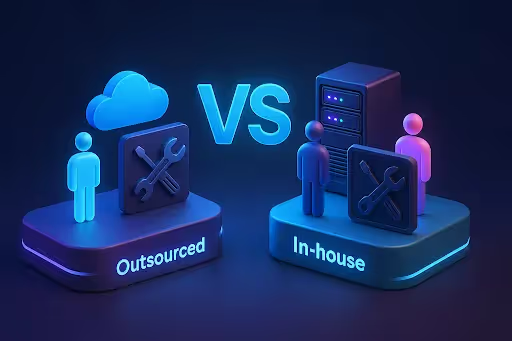
Building and maintaining an internal support team involves far more than salaries. The underlying operational and long-term costs can significantly increase the financial burden on a company.
Salaries and Benefits
Technical support engineers, DevOps specialists, QA staff, and IT administrators typically command competitive salaries. On top of that, companies must add:
These benefits can raise total labor costs by 20%–40% above salary alone.
Recruitment and Onboarding Costs
Hiring skilled technical staff requires:
These costs accumulate quickly, especially when turnover rates are high.
Training and Skill Development
Technology evolves rapidly, making continuous training essential. Organizations must invest in:
This is necessary to maintain expertise but increases long-term expenses.
Tools, Infrastructure, and Licensing
In-house teams require access to:
Many of these tools are subscription-based, adding recurring costs.
For many growing businesses, sustaining continuous availability becomes cost-prohibitive.
Compared to the layered expenses of internal teams, outsourced support offers a more predictable and often significantly lower cost structure.
When analyzing both models over a period of one to five years, outsourcing typically results in lower total costs, especially for small and mid-size companies or organizations with fluctuating workloads.
Outsourced maintenance and support generally provide a more flexible, scalable, and cost-efficient solution for most businesses. In-house teams offer more control, but the financial commitment is substantially higher, making outsourcing the more sustainable choice for organizations focused on long-term optimization and operational efficiency.
Performance and expertise play a decisive role in determining whether in-house or outsourced support can meet your operational demands. While both models have strengths, their capabilities differ significantly when it comes to technical depth, response efficiency, and long-term innovation.
Overall, while in-house teams excel in contextual knowledge and internal alignment, outsourced support typically delivers stronger performance, deeper technical coverage, and a more scalable expertise model, making it the more reliable choice for businesses aiming for long-term operational excellence.
Security and risk management are critical considerations when choosing between in-house and outsourced support, especially as businesses face growing concerns around data privacy, compliance, and system integrity. Each model offers different strengths and vulnerabilities that organizations must evaluate carefully.
Overall, in-house teams offer greater control, while outsourced support provides more advanced protection and defensive capabilities. When managed with proper contracts and governance, outsourcing tends to deliver stronger, more resilient security outcomes, especially for companies without dedicated cybersecurity expertise.
Outsourcing your maintenance and support to a trusted partner like Serdao can completely redefine how your business operates. Instead of being limited by bandwidth, skill gaps, or the ongoing pressure of managing internal teams, you gain access to a seasoned group of experts who specialize in keeping systems stable, secure, and optimized for growth.
Serdao brings structure, proven processes, and deep technical expertise that go far beyond what most companies can build on their own. With dedicated engineers, continuous monitoring, rapid incident response, and constant improvement built into the service, your operations become smoother and more predictable. You no longer have to worry about recruitment challenges, rising training costs, or the struggle to maintain 24/7 coverage.
What truly sets Serdao apart is the combination of flexibility and ownership. Instead of forcing you into rigid models, Serdao adapts seamlessly to your workflows, tools, and business goals. Every engagement is designed to enhance your internal capabilities rather than replace them, giving you a powerful extension of your team that elevates performance without adding complexity.
By partnering with Serdao, you unlock the freedom to focus on innovation and strategic initiatives while knowing that your systems are supported by professionals who care about your success as much as you do. The result is a more agile, resilient, and future ready operation that grows stronger with every release, every deployment, and every challenge solved together.
Conclusion
Choosing between in-house maintenance and outsourced support is ultimately about finding the model that empowers your business to operate with confidence, efficiency, and long-term scalability. While internal teams offer familiarity and direct control, outsourcing delivers broader expertise, stronger performance, and significantly lower operational burden. For companies navigating rapid growth, complex systems, or rising cost pressures, outsourcing becomes more than a tactical decision. It becomes a strategic advantage.
Partnering with an experienced provider like Serdao ensures you’re not just offloading tasks but elevating the entire foundation of your operations. From proactive monitoring to rapid issue resolution and continuous optimization, Serdao helps businesses transform their maintenance approach into a streamlined engine for reliability and innovation. By choosing the right support model and the right partner, your organization gains the freedom to focus on what matters most: building great products, serving customers better, and scaling without limits.